Excess ground humidity within Davidson County foundations creates an optimal harborage for subterranean termites, camel crickets, and wood-decay fungi. Unconditioned crawl spaces beneath older bungalows in East…
Excess ground humidity within Davidson County foundations creates an optimal harborage for subterranean termites, camel crickets, and wood-decay fungi. Unconditioned crawl spaces beneath older bungalows in East Nashville, Sylvan Park, and Belmont-Hillsboro frequently experience wood moisture content above 20 percent during humid Tennessee summers. At this saturation level, subterranean organisms digest framing timber and airborne fungal particulates migrate upward into living areas via the building envelope's stack effect. The U.S. Environmental Protection Agency confirms that managing indoor and sub-structural relative humidity below 60 percent is the primary mechanical mechanism for stopping fungal amplification and associated allergen spread.
Traditional vented foundation construction draws warm, moisture-laden air through foundation openings, which condenses across cool joists and trunk ductwork during June, July, and August. Crawl space encapsulation converts the vented cavity into a semi-conditioned building zone by installing continuous 12-to-20-mil multi-layer polyethylene across the dirt floor and perimeter walls, mechanically sealed according to U.S. Department of Energy crawl space insulation protocols. Perimeter penetrations, foundation piers, and crawl space access doors are sealed airtight, while an automated commercial crawl space dehumidifier maintains stable relative humidity levels between 45 and 55 percent, meeting ASHRAE moisture control standards.
Active pest intrusion relies directly on ambient groundwater. Subterranean termites construct mud tubes along concrete masonry piers to access framing timbers weakened by condensation, a vulnerability documented by the Purdue University Extension. Simultaneously, camel crickets (Rhaphidophoridae) and silverfish feed on organic mold and colonize dark sub-floors in Inglewood, Crieve Hall, and Donelson. Encapsulation removes the baseline standing moisture that fuels these infestations. When addressing historic homes in Germantown or slab-and-pier renovations in The Nations and 12 South, passive French drain installations and pressure-relief sump basins handle liquid water hydrostatic pressure before barrier placement, preventing soil bubbling under the membrane.
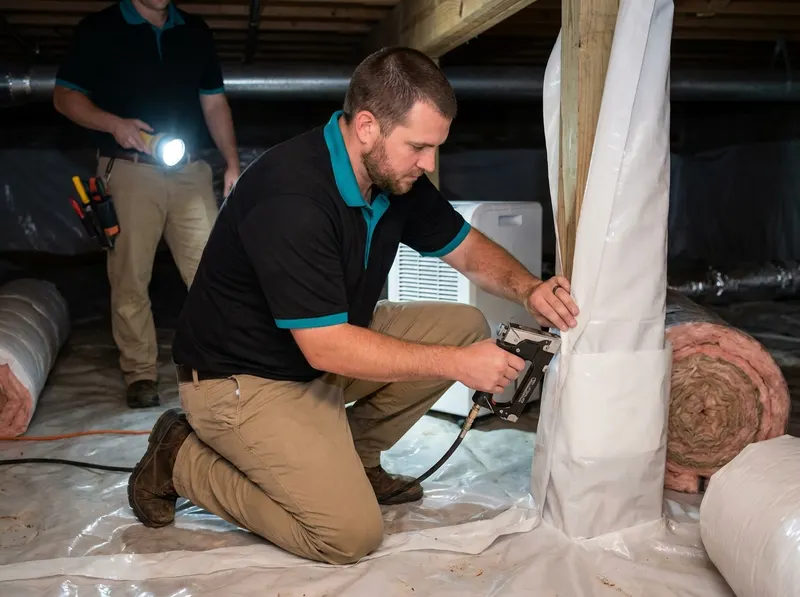
Step-by-step remediation begins with wood surface moisture readings, timber sanitation, and soil raking to remove biological debris. Technicians then hang thick, closed-cell barrier materials along interior foundation walls, leaving a visible 3-to-4-inch inspection gap below the sill plate to maintain InterNACHI and local building code termite inspection requirements. Condensate drain lines are routed to dedicated discharge points according to the International Code Council residential building guidelines. Grounded relative humidity monitoring monitors moisture trends continuously, safeguarding framing integrity and eliminating the chemical-heavy treatments historically used for damp-nesting pests.
Every job gets a firm, written price after a free on-site visit.
Tell us about your crawl space encapsulation and moisture management job in Nashville and we'll send a clear, written quote, usually the same day.
 BirchNova Exterminating