Pantry pest outbreaks typically begin when infested bulk grains, birdseed, or dried pantry items introduce microscopic larvae past home perimeters. In humid Davidson County climates, reproductive rates accelerate…
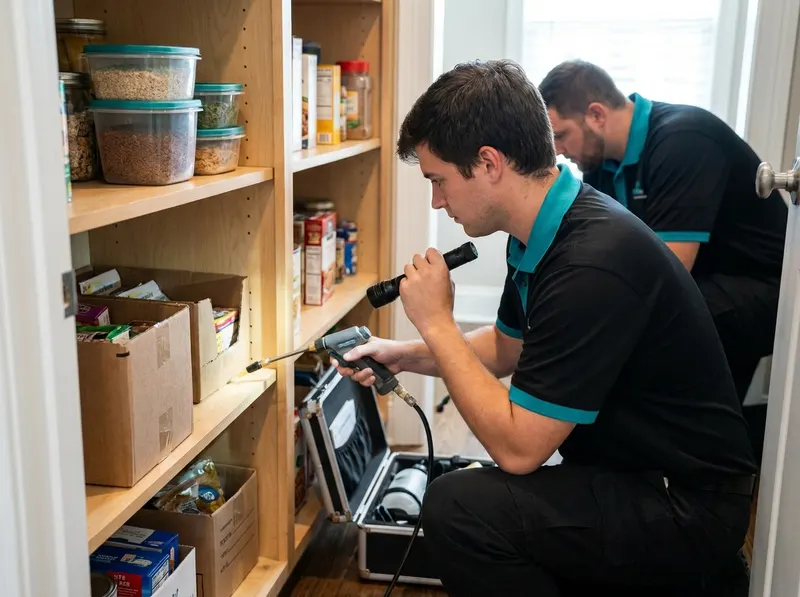
Pantry pest outbreaks typically begin when infested bulk grains, birdseed, or dried pantry items introduce microscopic larvae past home perimeters. In humid Davidson County climates, reproductive rates accelerate sharply, allowing populations of Indian meal moths (Plodia interpunctella) and flour-infesting beetles to cycle from egg to reproductive adult inside 30 to 45 days. BirchNova Exterminating addresses infestations through non-invasive structural cleanup and botanical or juvenile-hormone disruption rather than blanket neurotoxic sprays. A targeted eradication protocol is suited for single-room pantry pantries and kitchen food storage; broad broadcast residual sprays are inappropriate for residential areas where open food preparation occurs. The logistical trade-off centers on homeowner prep: clients must clear dry food storage areas and discard unsealed paper packaging so technicians can treat shelf peg-holes, cabinet seams, and baseboard junctions directly.
Technicians follow an integrated sequence to ensure complete population termination. Step 1 involves an exhaustive pantry inventory using high-lumen optical borescopes to examine structural gaps and cabinet backing boards. Step 2 applies HEPA-filtered vacuum extraction to lift pupae, webbing, and frass from structural recesses without dispersing particulate allergens. Step 3 deploys target-specific formulations certified under the EPA FIFRA Section 25(b) exempt framework or low-toxicity biorationals registered with the Tennessee Department of Agriculture. Step 4 institutes bio-monitoring via species-specific aggregation pheromones evaluated under Journal of Economic Entomology monitoring methodologies to detect post-treatment emergence.
Stored product pests exploit localized environmental conditions across Middle Tennessee. Older bungalows in East Nashville, Inglewood, and Belmont-Hillsboro frequently feature tongue-and-groove lath cabinetry, beaded board paneling, and heart-pine shelving with expanded seams where meal moth pupae spin protective silken cocoons. Modern builds in The Nations, Germantown, and 12 South often feature high-density unsealed particle board and floating pantry casework that conceal void spaces behind kickplates. Near riparian corridors like Shelby Bottoms Greenway, Centennial Park, and Radnor Lake State Park, higher summer relative humidity levels accelerate fungal growth within forgotten grain spills, providing food sources for foreign grain beetles. In expansive residential kitchens throughout Green Hills, Sylvan Park, Donelson, and Crieve Hall, multi-shelf walk-in pantries require systematic perimeter monitoring to verify that weevil colonies have not migrated into adjacent crawlspace access hatches or utility voids. Remediation guidelines established by the National Integrated Pest Management Network emphasize sanitation and mechanical barriers over excessive pesticide volumes, safeguarding human safety and non-target indoor environments.
Every job gets a firm, written price after a free on-site visit.
Tell us about your stored product pest eradication job in Nashville and we'll send a clear, written quote, usually the same day.
 BirchNova Exterminating