Subterranean termite colonies thrive in the moist, clay-dense soils of the Nashville Basin, frequently exploiting crawl spaces and basement foundations across East Nashville, Germantown, and Sylvan Park. The eastern…
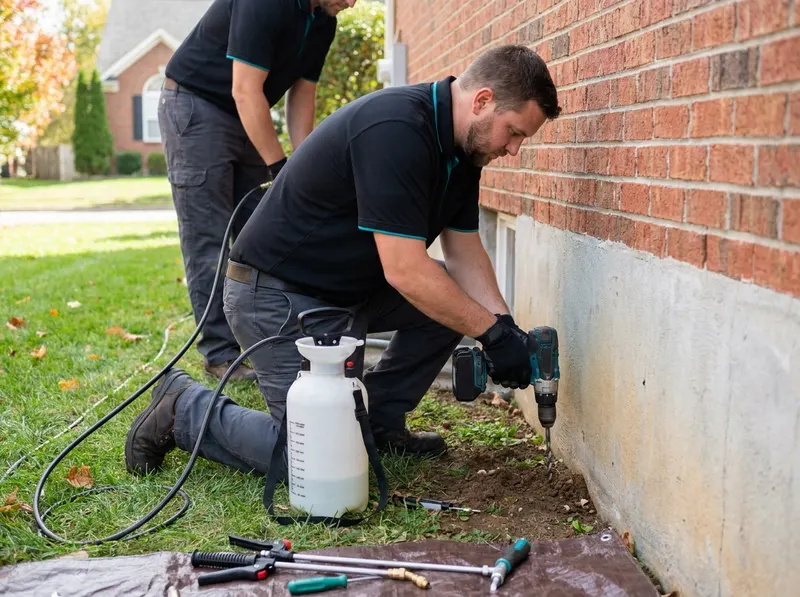
Subterranean termite colonies thrive in the moist, clay-dense soils of the Nashville Basin, frequently exploiting crawl spaces and basement foundations across East Nashville, Germantown, and Sylvan Park. The eastern subterranean termite builds mud shelter tubes upward from the soil to bridge concrete masonry foundation units and reach subfloor joists. According to biological data from the USDA Agricultural Research Service, subterranean colonies contain up to hundreds of thousands of individual workers constantly foraging for cellulose. Moisture retained along foundation perimeters, often exacerbated by older limestone masonry, downspouts discharging near footings, or dense shade near Percy Warner Park and Centennial Park, accelerates subterranean foraging activity. BirchNova Exterminating deploys targeted Integrated Pest Management principles to arrest colony movement without saturating indoor air registers or introducing unnecessary synthetic volatiles inside residential bedrooms.
Structural remediation requires establishing continuous non-repellent liquid barriers alongside vulnerable structural foundation walls. Unlike older repellent chemistries that scatter colonies to adjacent walls, modern non-repellent formulations adhere to workers as they pass through treated soil zones, enabling biological transfer throughout the subterranean colony nest. Technicians dig 6-inch by 6-inch trenches directly adjacent to exterior foundation grade beams, applying liquid barriers at precisely calculated dilution ratios specified by the Tennessee Department of Agriculture for structural wood-destroying insect management. In concrete-slab transitions typical of renovated garages in The Nations and Belmont-Hillsboro, specialized equipment drills precise 1/2-inch access voids spaced 12 inches apart to inject termiticide directly beneath adjoining patios before sealing with hydraulic cement, adhering to standards promoted by the National Pest Management Association.
Preventing ongoing structural failure requires differentiating subterranean termites from look-alike wood-destroying organisms. Subterranean termites leave smooth excavation galleries packed with brown mud fecal material, while carpenter ants clear polished galleries free of debris, as detailed by the University of Tennessee Extension entomology diagnostics. If localized dampness has caused structural fungal rot in older Donelson or Crieve Hall subflooring, structural moisture levels must also be lowered using American National Standards Institute building safety standards. BirchNova Exterminating bypasses mandatory recurring monthly chemical retainers; treatments focus on non-invasive barrier placement, targeted monitoring, and localized crawl space remediation designed to preserve indoor air quality according to CDC National Center for Environmental Health dwelling sanitation guidance. Homeowners coordinating an inspection can call (615) 537-0361 to confirm scheduling.
Every job gets a firm, written price after a free on-site visit.
Tell us about your subterranean termite treatment job in Nashville and we'll send a clear, written quote, usually the same day.
 BirchNova Exterminating